|
|
|
|
Top-of-mind topics for treasury and finance teams in the first half of 2025 make plain that NeuGroup members—as always—are laser-focused on risk mitigation and liquidity management while also adapting to what’s new and perhaps unexpected in the fast-changing and turbulent world around them.
- This year, the latter includes market volatility in response to tariffs, rising geopolitical risk amid wars, advances in AI adding pressure to further automate, and heaps of uncertainty about inflation, interest rates and economic growth. At the same time, of course, leaders are confronting the existential need to keep pushing treasury to be a creator of enterprise value.
- All those themes and more are reflected in the 10 posts below that stand out as the best NeuGroup Insights content in the last six months based on popularity among our subscribers. The posts include articles, videos and an episode of our podcast, the Strategic Finance Lab.
You can find many more insights, videos and podcasts on our website. Sign up for this email here, and subscribe to the Strategic Finance Lab podcast on Apple or Spotify.
|
|
|
|
|
|
|
|
|
|
|
NeuGroup members talk openly about TMSs, weighing traditional systems against modern, lighter-lift tools.
Treasury leaders committed to transformation face a slew of technology choices, ranging from traditional, fully integrated treasury management systems (TMSs) to newer, lighter-lift solutions from fintechs that may be more flexible and less clunky. Teams must weigh their needs based on size and complexity against the purchase price as well as the time, effort and costs of implementation, maintenance and updates. Some opt for all-encompassing platforms while others seek more nimble and customizable tools.
- That compelling context helps explain the high level of interest for a recent NeuGroup virtual session that drew more than three dozen highly-engaged members from companies of varying sizes. They joined to benchmark, share tips, exchange frank feedback about their experiences, and discuss the road ahead.
- The lively TMS discussion was led by NeuGroup senior executive advisor Paul Dalle Molle, who runs NeuGroup for Growth-Tech Treasurers. “Emerging companies often don’t have a TMS, but also don’t want to buy a full-blown one,” he noted during the session.
To read the full story, please click here.
|
|
|
|
|
|
|
|
|
A special episode of the Strategic Finance Lab features NeuGroup’s Joseph Neu in conversation with Laurence Tosi and Ed Barrie.
Treasury leaders who prioritize visibility, forecasting and control can do more than support the business—they can help build it. That’s the message from WestCap founder Laurence Tosi, who joined Treasury4 co-founder Ed Barrie in a special session moderated by NeuGroup founder and CEO Joseph Neu. Their conversation—now available on Apple and Spotify—focuses on what it means to adopt a “treasury-first mindset.”
- Mr. Tosi—a corporate finance veteran with CFO experience at Blackstone and Airbnb—shares his view that thinking treasury first is critical to creating sustainable value and exit readiness, especially for private companies and spin-offs. He explains how better cash visibility, FX optimization and data infrastructure helped him transform treasury into what he calls a “value creation center.”
- Mr. Barrie draws on his experience at Microsoft, Itron and Tableau to underscore the importance of automating data flows and enabling treasurers to deliver insights—not just reports. He also discusses the product vision behind Treasury4, a fintech created to support a data-driven treasury mindset.
Listeners will hear why WestCap chose Treasury4 as a strategic partner—and why Mr. Tosi believes treasury teams are uniquely positioned to prepare their companies for the future of real-time payments, secure money movement and embedded financial insight.
|
|
|
|
|
|
|
|
|
How treasury teams making share of wallet decisions evaluate banks based on quantitative and qualitative measures.
One treasury team tallying up the fees it pays banks in exchange for their commitments to the company’s revolving credit facility recently added a new category to its bank scorecard: deemed compensation on cash. Calculating it involves comparing the interest rate the corporate receives on cash held at a given bank to a benchmark rate such as fed funds.
- A member of NeuGroup for Global Cash and Banking explained the change at the group’s fall meeting in San Francisco in a broader discussion about bank scorecards, which some treasury teams use as they make share-of-wallet decisions. That’s the slice of the total pie of fees a company pays individual banks for being in their revolver.
A comprehensive scorecard. In addition to deemed compensation, the member’s scorecard tracks the fees the corporate pays to banks for capital markets transactions, custodial services, trust services, FX, the revolver, payment processing fees and other charges.
- “We total all that up and compare it to the revolver facility for each bank,” the member said. “Then we gauge what should their wallet share be. Then, are we over or under? And some of that is business driven, but some is more in our control.”
- The scorecard impressed other members, several of whom mentioned its comprehensiveness. One called it “super cool” and another said, “I wish we had that as well.”
To read the full story, please click here.
|
|
|
|
|
|
|
|
|
Chatham helped FMC benefit from centralized trading while preserving management reporting and local incentives.
The treasury team at agricultural chemical producer FMC Corp. slashed monthly FX hedging costs by 40% by partnering with Chatham Financial to develop a multicurrency netting approach that allows them—and now other multinational corporations—to manage balance sheet risk more efficiently. Members of NeuGroup for Mega-Cap Assistant Treasurers heard the details during a session at the group’s first-half meeting sponsored by Chatham.
- The new feature in ChathamDirect is “more than just centralized execution with automated back-to-back trades and accounting; it allows you to net different currency pairs into more liquid pairs, thereby maximizing economic offsets,” said Mike Burns, director of corporate treasury at FMC, who spoke at the meeting.
- Beyond reducing the cost of hedging, the ChathamDirect solution has enabled a fourfold increase in exposure tracking while simultaneously cutting the time FMC spent in its treasury management system at month-end by 50%—all while automating workflows that had previously required extensive human intervention.
- From exposure management to trade execution to accounting, “the automated end-to-end workflow combined with the multicurrency netting is a feature we couldn’t find anywhere else in the market,” Mr. Burns said. “It creates significant savings for the user; I think it will be a game changer for companies.”
To read the full story, please click here.
|
|
|
|
|
|
|
|
|
The effects of tariffs and changes in immigration policy on inflation, the economy and rates top the list of impacts.
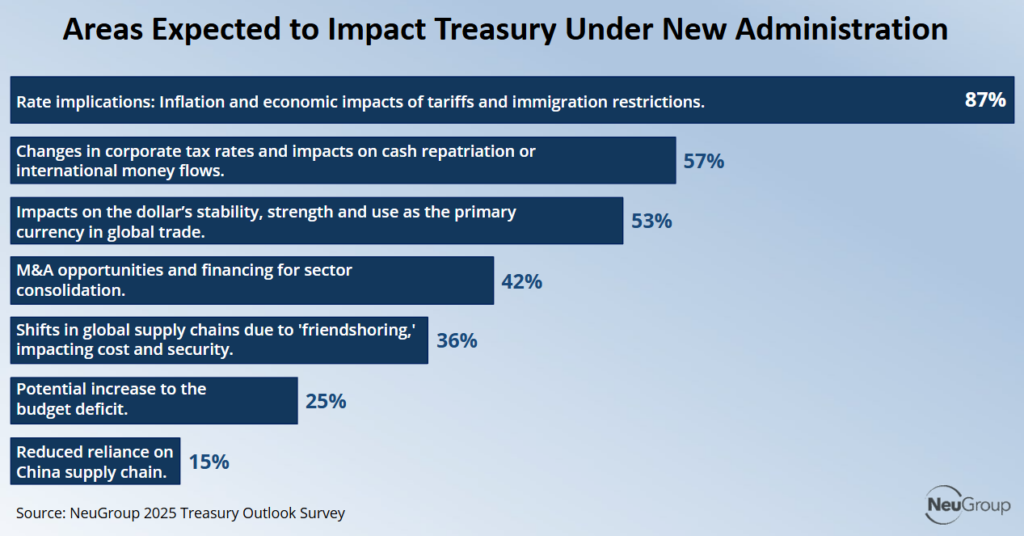
President Trump’s announcement last Saturday of 25% tariffs on imports from Mexico and Canada seemed to confirm the expectations of the vast majority (87%) of respondents to NeuGroup’s 2025 Treasury Outlook Survey who said tariffs would have the greatest impact on them of any changes under the new administration (see chart).
- “When he announced them over the weekend, it’s like everyone’s hair was on fire, and yet, we’ve been talking about this for months,” one treasurer at a mega-cap multinational told NeuGroup Insights.
- On Monday, Mr. Trump put the tariffs on Mexico and Canada on hold for 30 days. A 10% additional tariff on Chinese imports remains—at least for now (China retaliated).
- “The whole thing just leads to an incredible amount of uncertainty and unpredictability,” the treasurer said. While most corporates will wait before making major changes to supply chains, he added, “companies like ours are going to take whatever steps we need to take to get ready to ask for exemptions of certain goods.”
|
|
|
|
|
To read the full story, please click here.
|
|
|
|
|
|
|
|
|
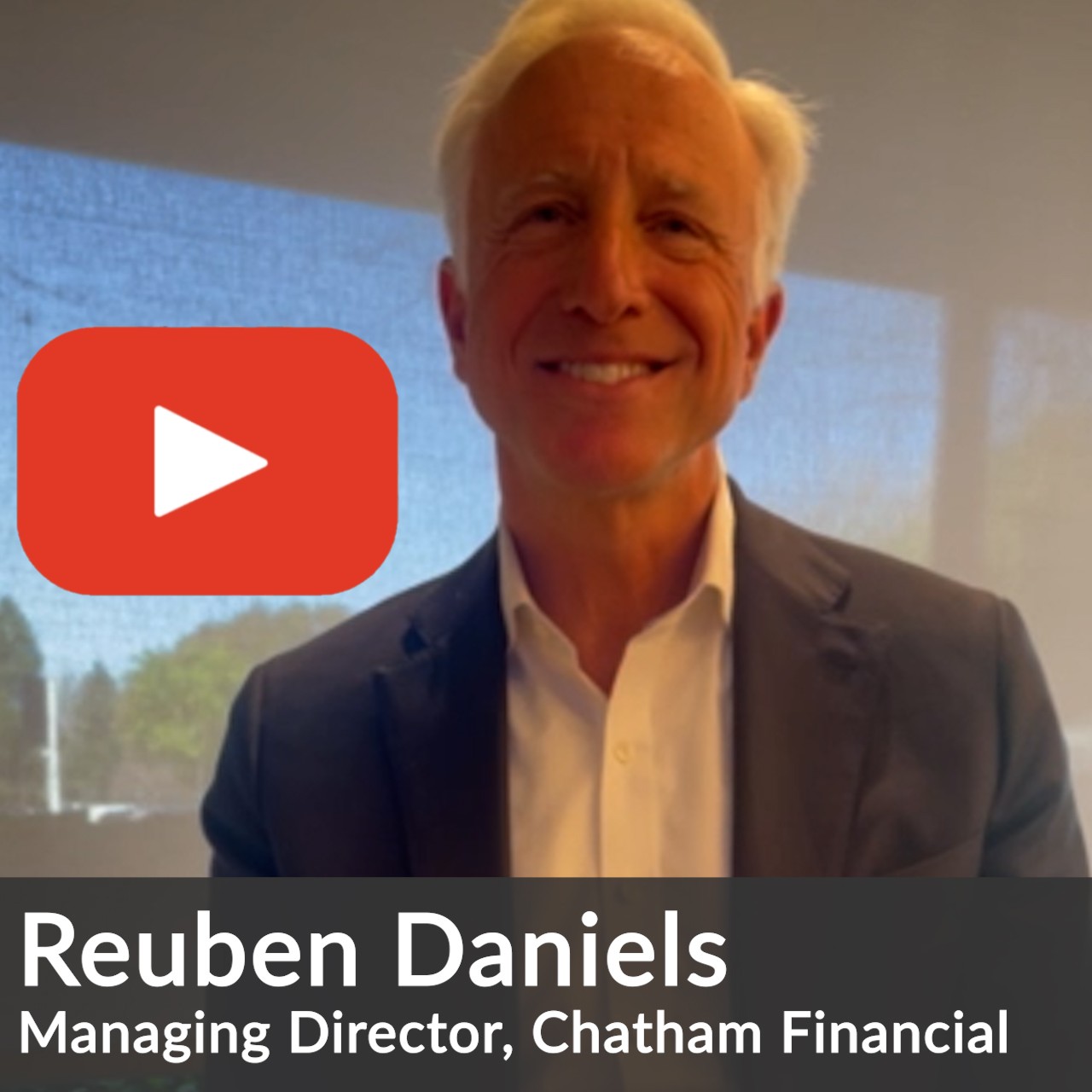
NeuGroup Video: Chatham Financial’s Reuben Daniels on the current curve and how investors view duration risk.
What does a U.S. Treasury yield curve that is neither steep nor inverted but looks something like the letter “u” mean for corporations that want to issue debt? Specifically, what does the u-shaped curve say about the appetite for risk and duration of fixed-income investors amid so much uncertainty about the economy, inflation and the Fed?
|
|
|
|
|
To read the full story, please click here.
|
|
|
|
|
|
|
|
|
Lessons learned by a NeuGroup member during a process of defining use cases, data mapping and system architecture decisions.
“How can we just have all the data in one place?” The answer to that simple, common question, recounted by a member of a treasury team in the throes of a transformation process designed to support their company’s rapid growth, has a relatively simple, predictable answer that can be difficult to achieve: build a data lake.
- The member shared lessons treasury has learned in building a data lake at a fall meeting of NeuGroup for Technology Advancement in San Francisco. Their presentation included detailed charts and tables explaining the approach as well as steps taken and planned to achieve the key objectives.
- “We are trying to build a solid foundation for the future and we wanted a centralized, single source of truth for all treasury data,” they said. “The goal is actionable insights, discoveries and observations that will scale and incorporate AI and machine learning models that offer predictive analysis.”
- Matt Thomas, a NeuGroup director of peer groups who led the session, observed that “member companies are evaluating data structures and systems to access actionable data that is as real-time as possible in an automated process.” He added, “Organizations will need to bring in outside experts or hire team members with implementation expertise. Technology is only one element; planning, assigning roles and continuity of updated processes are critical.”
To read the full story, please click here.
|
|
|
|
|
|
|
|
|
The benefits of a hedging method that may be underutilized by corporates managing FX risk in China and elsewhere.
The ability to hedge exposure to currencies onshore in China and other Asian markets instead of being limited to using offshore, non-deliverable forwards (NDFs) allows corporations to potentially reduce the costs of managing FX risk. That takeaway emerged during a presentation by MUFG at the NeuGroup for Tech Treasurers 2024 Tech Summit sponsored by the bank in November.
- “Having the setup so that you can access the onshore market when it is in your favor is absolutely something that we’re seeing more and more corporates do,” said MUFG’s Matthew Fennessy, Head of Global Subsidiary Sales and Acquisition Strategy in Asia.
- There are, however, challenges to overcome before you can take advantage. They include global time zones, know-your-customer (KYC) hoops and documentation of the transactions being hedged. These are among the reasons not all corporates make use of onshore hedging.
To read the full story, please click here.
|
|
|
|
|
|
|
|
|
How AI can improve risk assessment and decision-making, helping corporates move faster and smarter.
Rising premiums coupled with elevated rates of natural disasters are forcing corporates to make smarter, faster decisions around risks and coverage levels. But the avalanche of data that ERM and insurance teams must sift through to improve decision-making can also slow down the process.
- In a new NeuGroup Insights video clip from an episode of the Strategic Finance Lab podcast, Brian Hagen, a seasoned corporate risk and insurance expert, offers a compelling vision for a future populated by so-called AI agents that aid senior leadership in high-stakes decisions, enhancing their ability to digest this data and act with confidence and speed.
- Mr. Hagen, an adjunct professor of enterprise risk management at California State University, Fullerton, has spent decades refining how organizations quantify and navigate risk. His career spans leadership roles at Decision Empowerment Institute and Strategic Decisions Group, where he has helped businesses across industries—from biotech to energy—optimize strategic choices.
Framing the data. In the video, which you can watch by clicking here, Mr. Hagen discusses one of his key concepts of decision-making: the “decision frame.” In an era of information overload, not all data is equally useful. A decision frame structures a problem, risk or opportunity, outlining what’s relevant and what’s not.
To read the full story, please click here.
|
|
|
|
|
|
|
|
|
Treasury’s shift from spreadsheets to AI-driven forecasting enabled smarter decisions, deeper analysis and better alignment with corporate strategy.
When the treasury team at Moody’s Corp. found themselves constrained by fragmented bank connectivity and Excel-based forecasting, they turned to machine learning to modernize the process. By implementing a forecasting solution within ION’s Reval TMS, they automated manual workflows, improved forecast accuracy and freed the team to focus on value-added analysis—winning Treasury Management International’s 2025 award for Best AI Automation.
- At NeuGroup’s recent Treasurers Symposium, chief treasury officer Deepali Chawla and treasury VP Amit Bhatt shared that the project delivered more timely, accurate forecasts while allowing treasury to dedicate more time to strategic decision-making.
- “The teams working on the forecasting are now able to shift their workload, going from cleaning up errors and cleaning up Excel to doing work that’s more value-add,” Mr. Bhatt said. “The teams doing the work felt that they now won’t be spending hours going through the files.”
- They are now using forecasts to inform decisions around liquidity, repatriation timing and working capital—decisions that previously would have depended on manual analysis and lagging data.
To read the full story, please click here.
|
|
|
|
|
|
|
|
|
In this joint session for bank treasurers and their teams, members will benchmark strategies and approaches to non-maturity deposit modeling amid evolving client behavior, competitive pressures and interest rate volatility. Discussion topics include the treatment of retail, operational and non-operational deposits, updates to products, channels and client cohorts, and more.
|
|
|
|
|
NeuGroup for Working Capital Optimization will explore how Accell Group, a European e-bike leader, addressed complex cross-border receivables with a €100M trade receivables securitization executed in just 12 weeks. Participants will learn how the company overcame regulatory and operational hurdles across 31 jurisdictions with help from Demica (recently acquired by and now operating under FIS) while managing internal alignment, business growth and sustainability goals.
|
|
|
|
|
As insurance markets pull back coverage for high-severity, low-frequency risks, corporate leaders are evaluating alternative risk transfer solutions. In this member-led session, participants will share how their teams are assessing and applying tools such as parametric insurance, catastrophe bonds and insurance-linked securities.
|
|
|
|
|
|
|
|
|
|
|
|
|